
Darul hikmat (Hifz Program)
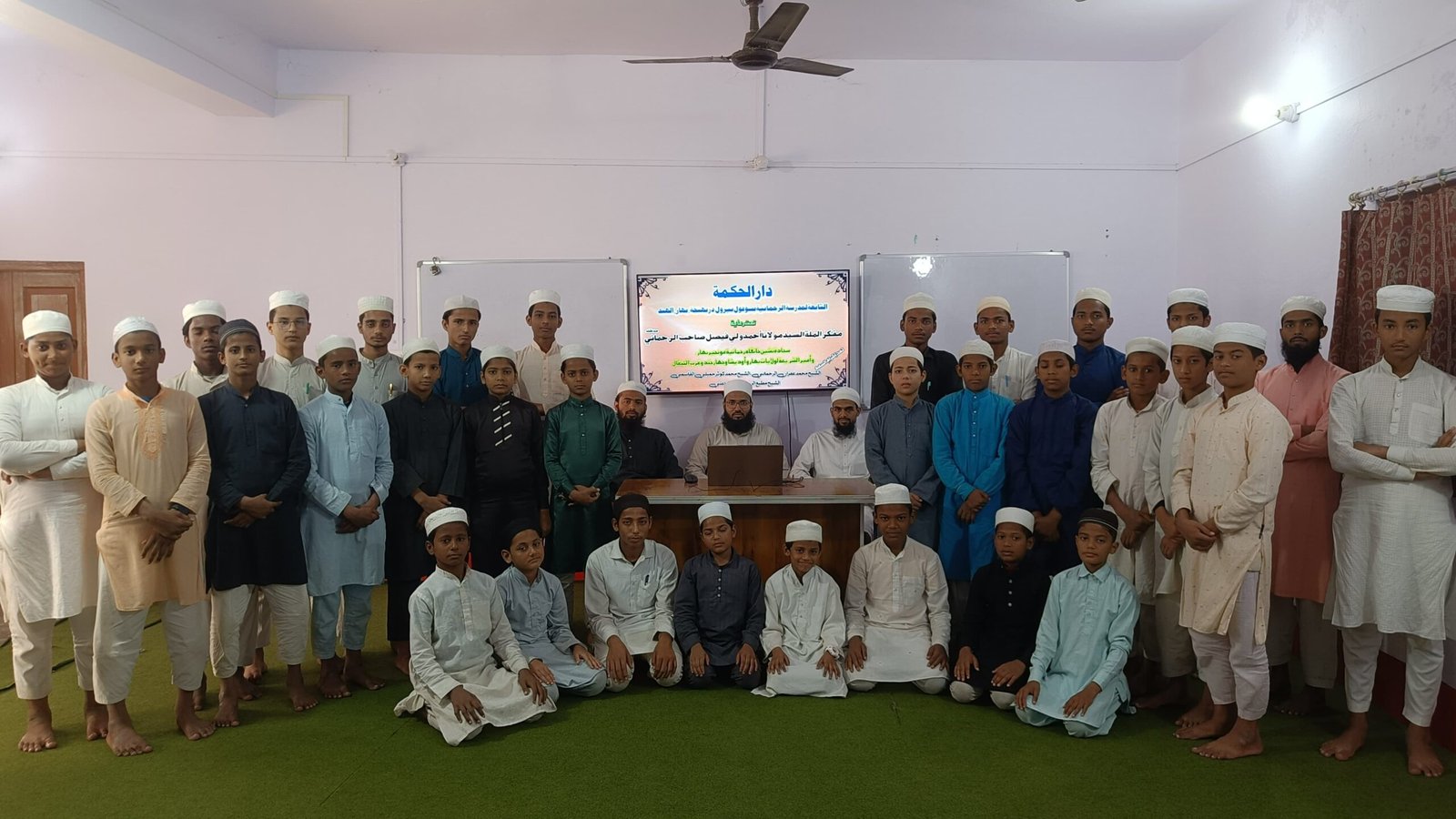
Dar al-Hikmah – Madrasa Rahmaniya, Supaul
Establishment and Background
Introduction
All praise is due to Allah! In the scholarly and intellectual journey of Madrasa Rahmaniya, Supaul, Darbhanga, 5 May 2025 stands as a highly blessed and memorable day. On this day, the esteemed President of the Madrasa, Ameer-e-Shariat Hazrat Maulana Ahmad Wali Faisal Rahmani Sahib (may Allah protect him), after consultation with the teachers and responsible members of the institution, established the Department of Dar al-Hikmah in this Madrasa, and he personally graced its inauguration.
This establishment is, in fact, a continuation of the grand educational vision of Central Dar al-Hikmah, Jamia Rahmani, Munger, which holds a distinguished identity in its structure, objectives, and standards.
Establishment and Background
The foundation of Dar al-Hikmah at Jamia Rahmani, Munger was laid by the eminent Islamic thinker Hazrat Maulana Syed Muhammad Wali Rahmani (may Allah have mercy on him) on 10 Rabi’ al-Awwal 1433 AH / 3 March 2012.
Its objective was to bring together the best features of religious and modern educational institutions of the Indian subcontinent and to design a comprehensive and integrated curriculum. According to this curriculum, students are educated in such a way that they become strong memorizers of the Qur’an and excellent Islamic scholars, while also attaining proficiency in Arabic, English, Urdu, and Hindi, along with familiarity with science, mathematics, and modern technology.
With this aim, the curricula, teaching systems, and educational structures of many reputable institutions from India, the United Arab Emirates, Qatar, Egypt, Saudi Arabia, Turkey, and the United States were studied in depth. This scholarly and research-oriented process involved distinguished teachers of Jamia Rahmani, Munger, and internationally renowned education experts, especially:
- Ameer-e-Shariat VII, Hazrat Maulana Muhammad Wali Rahmani (may Allah have mercy on him)
- Hazrat Maulana Ahmad Wali Faisal Rahmani Sahib
- Shaykh Dani Duwairi (Lebanon)
- Dr. Baraa Safwan (Egypt)
- Dr. Syed Rajab Qazamil, Dean, Faculty of Shariah, Al-Azhar University (Egypt)
- Dr. Mahmood Abdul Hamid Al-Shazli (Egypt)
- Dr. Sha’ban Jabir Sha’ban (Egypt)
- Dr. Al-Sayyid Abu Ni’mah Al-Tuhami (Egypt)
- The expert scholars of Jamia Rahmani Khanqah, Munger, especially all the teachers of Dar al-Hikmah, Jamia Rahmani
After extensive consultations, research, and numerous deliberative sessions with these outstanding personalities, a comprehensive and well-rounded curriculum was developed, which later became the educational soul of Dar al-Hikmah. The same curriculum, with the same order and quality standards, has now been implemented in the Dar al-Hikmah Department of Madrasa Rahmaniya as well.
Its establishment is not only a significant addition to the educational history of Madrasa Rahmaniya, but also clear evidence that this institution seeks to incorporate the demands of the times, intellectual maturity, contemporary awareness, and religious insight into its educational direction. It is hoped that Dar al-Hikmah here too will enlighten minds, broaden perspectives, and guide students on a path through which they may become beneficial leaders of the Ummah and expert scholars of Islamic sciences.
By the grace of Allah, this department is currently making highly satisfactory progress toward a new direction of educational development under the farsighted patronage of Ameer-e-Shariat of Bihar, Odisha, Jharkhand, and West Bengal, Hazrat Maulana Ahmad Wali Faisal Rahmani Sahib (may Allah grant him lasting blessings).
Insha’Allah, the establishment of this department will prove to be a milestone in the scholarly environment of Madrasa Rahmaniya. We pray that Allah Almighty grants this department further progress and permanence, and makes it a means of greater excellence and stability in the educational services of Madrasa Rahmaniya, Supaul. Ameen.
The basic objectives of establishing Dar al-Hikmah are as follows:
- To prepare individuals who can speak and write the Arabic language like their mother tongue.
- To promote and spread the Arabic language widely.
- To develop the ability to benefit directly from the original sources of Islam through the Arabic language.
- To prepare individuals who understand the Qur’an deeply and promote Qur’anic understanding in an active and dynamic manner.
- To train individuals equipped with such knowledge and skills that society and the community need in a timely manner.
- To cultivate individuals with a strong research-oriented mindset.
Dar al-Hikmah trains such strong memorizers of the Qur’an and excellent Islamic scholars who:
- Are firmly grounded in religious sciences and proficient in Arabic language and literature.
- Are familiar with beneficial sciences such as science, mathematics, and modern technology.
- Can understand the meanings and concepts of the Qur’an and Hadith with insight and explain them to others.
- Can derive solutions to contemporary issues from the Qur’an, Hadith, and jurisprudential sources according to present-day needs.
- Always remain seekers of knowledge, possessing the courage to think innovatively and strive for higher achievements.
- Are good critics, followers of positive thought and action, people of high moral character, and bearers of Islamic identity.
- Fulfill the responsibilities of leadership, da’wah, and tabligh for the Ummah by accepting challenges according to the demands of the time.
A special education system has been designed for Dar al-Hikmah, in which Arabic is the medium of instruction. Except for Persian, Urdu, and English, all subjects and disciplines included in the curriculum—such as mathematics and science—are taught in Arabic.
Students who are engaged in memorizing the Holy Qur’an spend only two hours daily on Arabic language and other subjects, while the remaining time is devoted exclusively to memorization. After completing the memorization of each juz’ (part) of the Qur’an, students are required to recite it before another teacher as well. Only those students are deemed eligible for the certificate of Qur’anic memorization and the turban ceremony who recite the entire Qur’an within six days.
At the end of each subject, both oral and written examinations are conducted. In monthly examinations, only those students are considered successful who obtain 75% marks. Students who fail to meet this standard are given additional time by the teachers to overcome their academic weaknesses.
Various academic and cultural programs are organized, in which special importance is given to the Arabic language. To develop proficiency in Arabic language and literature among students, modern and high-quality books are included in the curriculum, consisting of pure Arabic expressions, literary and reformative essays, objectives, and exercises.
To improve Arabic pronunciation and listening comprehension, arrangements are made to show and play Arabic videos. Modern technology is used in teaching, and engaging and innovative teaching methods are adopted.
Students are instructed to speak in Arabic both inside and outside the classroom, so that an Arabic environment is established and students develop the ability to speak and understand Arabic—the language of the Qur’an and Hadith—naturally and confidently.
At Dar al-Hikmah of Madrasa Rahmaniya, Supaul, Darbhanga, efforts are gradually being made to implement all these arrangements and principles as well. May Allah grant that, like the Central Dar al-Hikmah of Jamia Rahmani Khanqah, Munger, the efforts of Dar al-Hikmah here too bear fruitful results. Ameen.
The academic and intellectual supervision of the Department of Darul-Hikmat is entrusted to the esteemed scholars listed below:
This department is, in essence, an intellectual and spiritual academy where the memorization of the Qur’an is combined with wisdom, insight, scholarship, practice, character-building, and spiritual refinement. Its purpose is to prepare a new generation illuminated with true knowledge, sound understanding, and noble Islamic character—so that they may guide themselves and the Ummah with the light of faith and wisdom.